

Procrastination: you are not lazy
We have all been there: a deadline is looming or a project needs starting, yet you find yourself scrubbing the kitchen floor or lost in an endless social media scroll. Usually, this is followed by a heavy dose of guilt.
But what if your inability to start is not a sign of laziness? What if it is actually your body and mind trying to protect you?
Where it comes from
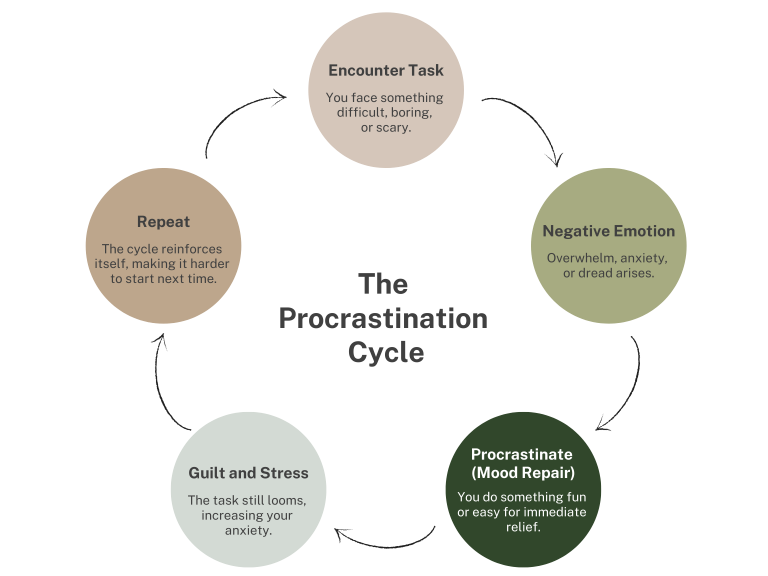
Procrastination is primarily an emotional regulation strategy. When your nervous system perceives a task as “dangerous” or uncomfortable, it triggers a survival instinct. Your brain does not see a to-do list; it sees a threat to your emotional safety.
Often, this manifests as a Freeze Response. To protect you from the discomfort of the task, your system pulls the emergency brake to keep you from entering what it perceives as a danger zone.
The Emotional Drivers: When Overwhelm Takes Over
While the body freezes, the mind is busy trying to navigate companion emotional states that aggravate the urge to avoid.
Overwhelmed
This is often the primary trigger. When a task feels too big, too complex, or carries too much importance, your system experiences "too muchness." Instead of processing the task, your brain short-circuits and decides the only safe option is to do nothing at all.
Mood Repair
Putting off a task provides immediate relief. Your brain gets a quick dopamine hit from a distraction, which rewards you for avoiding the "scary" or "big" thing.
Perfectionism
The belief that you must do something perfectly can make starting feel impossible. If you cannot guarantee a perfect result, your system decides it is safer not to try.
Low Self-Efficacy
If you lack confidence in your ability to finish the task, your brain will prioritise immediate comfort over your long-term goals.
What it feels like
It feels like a physical barrier between you and the work.
The Fog: Your brain feels muddy and you cannot find a starting point.
The Weight: Your limbs feel heavy, as if even small movements require massive effort.
The Numbness: You find yourself staring at a screen or a wall, completely checked out and unable to focus.
How the Inner Critic reacts
This is where the shame cycle starts. Your inner critic kicks in with a harsh narrative:
“Why are you so lazy?”
“Everyone else can do this, why can’t you?”
“You are failing because you have no discipline.”
Procrastination is a form of anxiety that gets mislabeled as a character flaw.
What your body is actually trying to do
Your body is actually being kind to you. It has detected high levels of stress and decided that the safest thing for you to do is stop. By immobilising you, it is trying to shield you from a perceived emotional hit, the pain of failure, or the exhaustion of overwhelm. It is a learned behaviour that likely served you at some point in your past.
How to rethink it: A kinder approach
Instead of fighting your body with more willpower, try to understand what your mind and body are trying to do.
- Notice the sensation: “I feel heavy and foggy. My system is feeling overwhelmed and is trying to protect me.”
- Lower the threat: Remind your system that you are safe. “This is just an email. It is not a threat to my worth.”
- Shrink the task: If you are overwhelmed, pick one tiny movement. Not the whole project, just opening the document or clearing your desk.
- Offer a small win: Do not try to finish. Just move your body slightly—stretch or drink water—to show your nervous system it is safe to move again.
Moving beyond the loop
While these tools help in the moment, procrastination is often a sign of a deeper, recurring pattern. To truly break the cycle, we have to look at the “why” behind the freeze. In Root Cause Therapy sessions, we work together to find the specific “why” behind the freeze. By identifying the old experiences or beliefs that keep your system on high alert, we can help your body finally let go of the need to protect you through avoidance.
When we stop punishing ourselves for being stuck, we take away the fuel that keeps the Freeze response alive. Understanding your body is the first step toward reclaiming action.
Nelia Joubert-Hartman
Nelia’s background includes training in trauma-informed coaching, Root Cause Therapy, and change management, with a strong focus on pattern recognition, emotional awareness, and sustainable behaviour change. She has also trained in facilitation for small and large groups.


Leave a Reply